
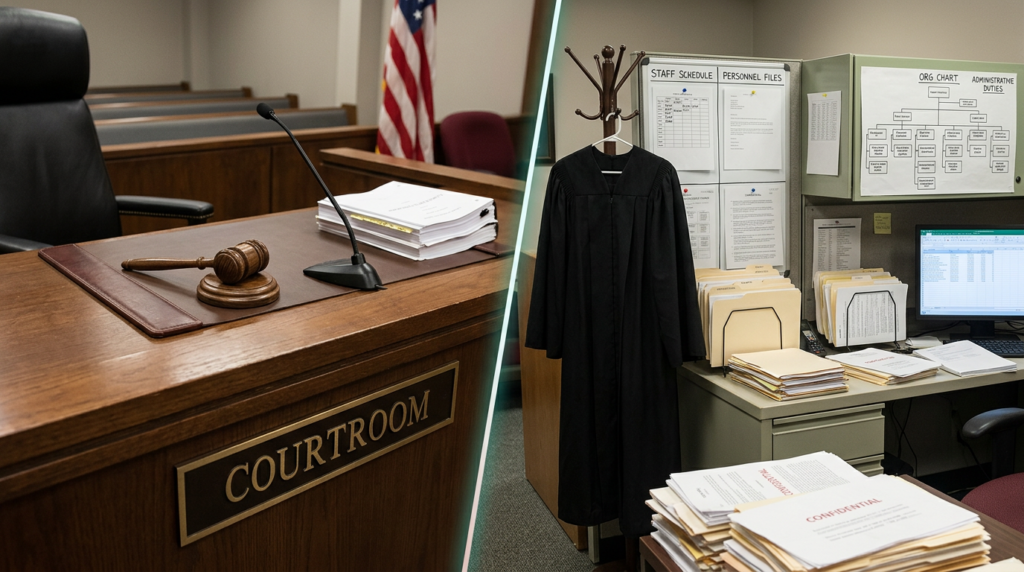
On February 18, 2026, the ABA Standing Committee on Ethics and Professional Responsibility issued Formal Opinion 521, “The Judicial Canons of Ethics Applicability to the Administrative and Supervisory Role of a Judge.” The opinion’s premise is that judicial ethics don’t stop at adjudication. A judge who never issues a biased ruling can still violate the Model Code of Judicial Conduct through hiring, supervising, or the use of the informal authority that comes with the office.
The opinion builds its argument from four provisions of the Model Code:
- Canon 1 and Rule 1.2 require judges to avoid impropriety and the appearance of impropriety, and to act in a manner that promotes public confidence in the judiciary’s independence, integrity, and impartiality — in every professional context, not just rulings.
- Canon 2 and Rule 2.3 extend the “no bias or prejudice” requirement to administrative duties, and separately bar judges from engaging in or permitting harassment or discrimination by court staff. The comment to Rule 2.3 notes that bias can show up in surprisingly small ways — demeaning nicknames, humor built on stereotypes, even body language.
- Rule 2.12 imposes an affirmative supervisory duty: judges must require court staff and others under their direction to act consistently with the judge’s own ethical obligations. This duty is active, not passive — a judge who becomes aware of biased or unethical practices in the court’s operations has to do something about it.
- Rule 2.13 requires that appointments and personnel decisions — hiring law clerks, assigning indigent-defense cases, filling internships — be made impartially and on the basis of merit, avoiding nepotism and favoritism.
The throughline is that public confidence in courts depends on more than what happens in the courtroom. As the opinion frames it, judicial fairness has to be real, and it has to be seen to be real.
Opinion 521 works through the following hypotheticals to show how ordinary-seeming administrative choices can cross the line:
- The alma mater pipeline. A judge running a courthouse internship program consistently invites applicants only from her own law school. No discriminatory intent is required for this to violate the Code — the pattern itself creates an appearance that opportunities are reserved for an in-group rather than allocated on merit, and misuses judicial prestige (Rule 1.3) to favor an institution the judge is personally tied to.
- The neighbor under investigation. A state supreme court justice learns that her neighbor is the subject of a criminal investigation for misusing public funds. Believing the investigation is unfair, she privately contacts senior executive officials to try to have it halted or redirected. The opinion is unambiguous here: even if she’s motivated by loyalty or a genuine belief the investigation is unjust, using — or appearing to use — judicial prestige to influence another branch of government on a personal connection’s behalf violates Canon 1, Rule 1.2, and Rule 2.4(B)’s bar on letting social relationships influence judicial conduct. Notably, the opinion says intent barely matters: even an unsuccessful attempt to intervene creates the appearance problem.
- The nepotistic appointment. A judge appoints his own newly licensed son to the indigent-defense list without any competitive process, explaining that his son is qualified. The opinion rejects that defense outright — competence doesn’t cure the appearance of favoritism; the nepotism itself is the violation.
- Excluding lawyers by viewpoint. A judge declines to appoint qualified attorneys from advocacy organizations to the indigent-defense list, citing concern about their political views. Even framed as protecting neutrality, this substitutes ideological judgment for merit-based selection.
- Retaliation for an accommodation request. A courtroom deputy asks for a disability accommodation; the judge responds by loading the deputy with undesirable assignments. Other staff notice and read it as a warning. The opinion treats this as both a Rule 2.3 bias violation and a Rule 2.12 supervisory failure.
- Tolerated workplace bias. A judicial assistant routinely uses demeaning nicknames and stereotyped “jokes” toward staff; the judge is aware and dismisses it as harmless. The opinion says the assistant’s lack of malicious intent is not a defense — what matters is the effect and the perception it creates, and the judge’s inaction is itself a supervisory failure under Rule 2.12.
Across all six scenarios, the opinion returns to the same test: not whether the judge’s motives were good, but whether a reasonable observer could conclude that personal relationships, ideology, or bias (rather than merit and law) drove the decision. And a pattern of small, individually defensible acts can add up to an appearance-of-impropriety problem even where no single act violates a specific rule.
We’ve seen these types of cases come to light throughout this year. A Second Circuit Judge was publicly reprimanded for mistreating her law clerks, then faced a second misconduct complaint this year alleging she continued the same conduct. (Above the Law). And a federal district judge in Atlanta was disciplined this year after an investigation found she’d had sex in chambers with a police officer within earshot of staff and then lied to investigators about it — conduct well outside the adjudicatory role, but squarely the sort of thing covered by Canon 1’s “avoid impropriety and its appearance” standard. (CNN).
The ABA opinion closes with concrete suggestions for courts and judges looking to put these principles into practice: clear, merit-based selection criteria for appointments and internships; transparent processes for recurring discretionary decisions; training for judges and staff on supervisory obligations and workplace fairness; and prompt, impartial procedures for handling allegations of staff misconduct.
