
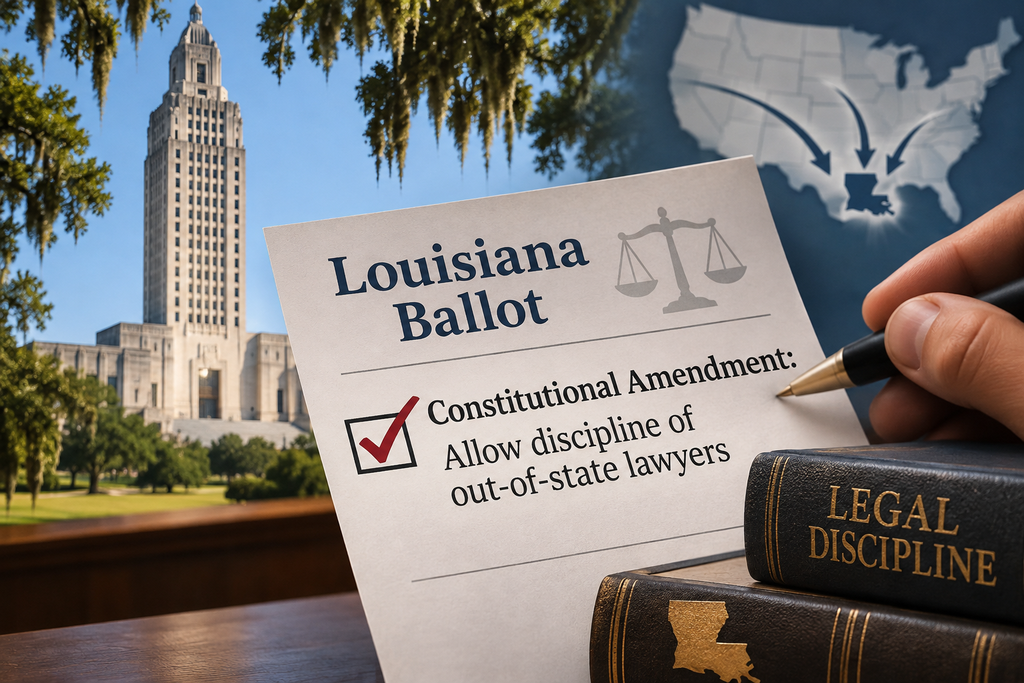
On April 17, 2027, Louisiana voters will decide whether the state Supreme Court’s power to discipline lawyers should reach beyond members of the Louisiana bar. The question comes from Act 38 of the 2026 Regular Session, Senate Bill 68 by Sen. Jay Morris, and it was the first measure in any state certified for a 2027 ballot.
If it sounds familiar, it should. A narrower version lost in March 2025, but that time it was packaged with a far more contested idea. Here’s what this one does, why it’s back, and what to weigh before you vote.
The proposition you’ll see on the ballot reads:
Do you support an amendment granting the Louisiana Supreme Court the authority to discipline out-of-state attorneys in certain circumstances? (Amends Article V, Section 5(B))
Today, Article V, Section 5(B) of the Louisiana Constitution gives the Supreme Court exclusive original jurisdiction over disciplinary proceedings against “a member of the bar” — lawyers licensed in Louisiana. Original jurisdiction means those cases are decided by the Supreme Court itself rather than starting in a lower court.
The amendment keeps that sentence and extends it to four more groups of lawyers (résumé digest):
| Who the court could discipline | What that looks like in practice |
|---|---|
| A lawyer specially admitted by a Louisiana court for a particular proceeding | An out-of-state attorney allowed in to handle one case |
| A lawyer not admitted in Louisiana who practices law or offers legal services here | Someone licensed elsewhere who signs up Louisiana clients |
| A lawyer licensed in another state who owns or operates a law firm in Louisiana | An out-of-state owner running a Louisiana office |
| A lawyer not licensed in Louisiana who supervises Louisiana-licensed lawyers | A managing attorney elsewhere directing a Louisiana team’s work |
The first two groups were in the 2025 version. The last two are new, and they reach the people who run a firm, not just the lawyers whose names appear on the filings. The amendment changes nothing about who may get a Louisiana license; it only settles who the court can discipline.
Why it’s on the ballot: the hurricane lawsuit fallout
The push traces back to Hurricanes Laura, Delta and Ida. Houston-based McClenny Moseley & Associates (MMA) filed more than 2,000 hurricane-damage lawsuits in Louisiana, and in 2023 the operation came apart:
| When (2023) | What happened |
|---|---|
| March 3 | The Louisiana Supreme Court suspended William Huye, MMA’s managing Louisiana attorney (Insurance Journal) |
| March 4 | U.S. District Judge James Cain Jr. suspended the firm and its lawyers from the Western District of Louisiana (Claims Journal) |
| May 10 | The Supreme Court froze every MMA hurricane suit in state court (KPLC) |
| May | The court named a special trustee to help MMA’s former clients find new lawyers; the insurance commissioner had fined the firm $2 million (Claims Journal) |
The court could act against Huye because he was a member of the Louisiana bar. Sen. Morris has argued it had no such reach over the out-of-state lawyers behind the operation, calling them “pretty bad actors” whom the court was powerless to stop.
Haven’t we voted on this already?
Sort of. On March 29, 2025, Amendment 1 asked two things in one question: should the Supreme Court discipline out-of-state lawyers, and should the Legislature be able to create trial courts of limited and specialized jurisdiction? It lost 412,108 to 221,355, and all four amendments failed that day on turnout just over 21%.
Most of the fight was over the courts half. Opponents warned that new courts could be used to route cases away from judges lawmakers disliked, and that the wording was too vague (State Court Report).
| March 2025 (Amendment 1) | April 2027 (Act 38) | |
|---|---|---|
| Lawyers covered beyond the Louisiana bar | Specially admitted lawyers; unlicensed lawyers offering services here | Those two, plus out-of-state firm owners and unlicensed supervisors |
| Bundled with | New specialty trial courts | Nothing |
| Legislative vote | All Republicans for, most Democrats against | Unanimous in both chambers |
| Result | Rejected, about 65% no | Decided April 17, 2027 |
That makes 2027 the first time voters will weigh the lawyer-discipline question on its own.
What supporters argue
- It closes a gap in the text. The constitution names only members of the bar, and Morris has described the missing out-of-state coverage as a loophole (WAFB).
- It puts existing practice on firmer footing. The court already believes it has this power; the amendment writes it into the constitution (KALB).
- It reaches who runs the firm. Out-of-state owners and supervisors would answer to the same court as the Louisiana lawyers they direct.
- It protects people after disasters, when homeowners are most likely to be approached by unfamiliar firms.
What critics have raised
These points come from the 2025 debate; groups may view the standalone version differently.
- Is it needed? The ACLU of Louisiana argued that laws to discipline out-of-state attorneys already exist (Red River Radio). PAR noted the court’s own rules already cover specially admitted and out-of-state lawyers (PAR).
- What would discipline mean in practice? Louisiana can’t revoke another state’s license. Its main tool would be barring someone from Louisiana work, with home states deciding whether to follow.
An open question
Neither the amendment nor its digest defines what it means to “own or operate” a law firm here. How far that reaches, for example to national firms with Louisiana offices, would be up to the court.
What your vote means
- YES: The Supreme Court gains explicit constitutional authority to discipline the four groups above, alongside Louisiana-licensed lawyers.
- NO: Article V, Section 5(B) stays as written, covering members of the bar only. The court’s existing rules on out-of-state lawyers stay in place, without the new constitutional backing.
The vote is Saturday, April 17, 2027.
