
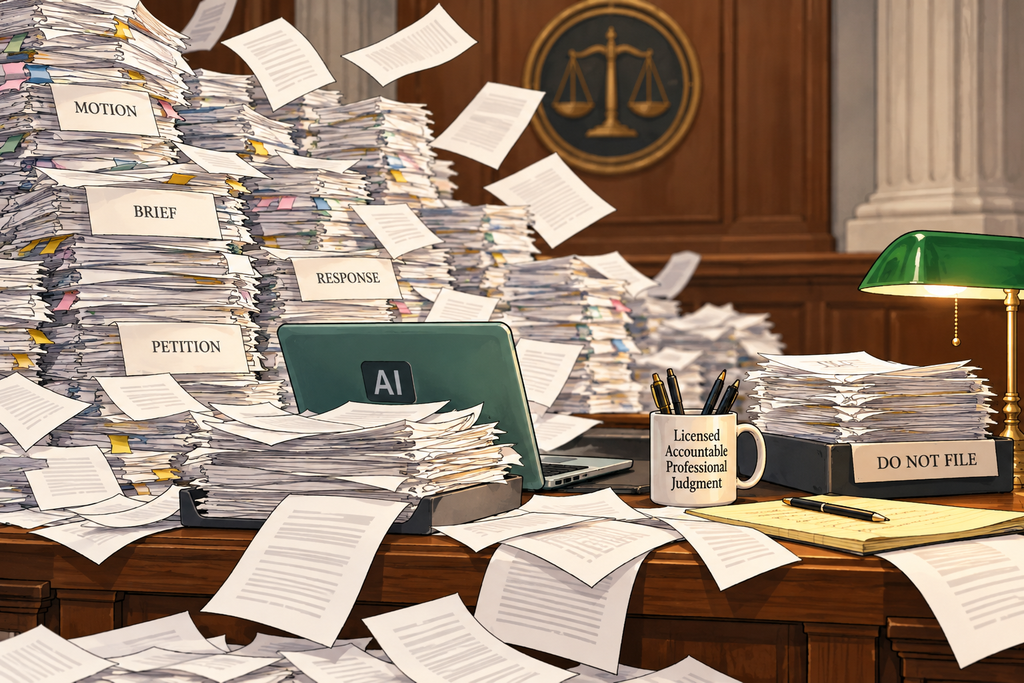
This week, Dane and I spoke about artificial intelligence at a CLE for the National Association of Administrative Law Judiciary. We have given quite a few presentations about AI to lawyers, but speaking with administrative law judges offered a different perspective on how this technology is changing the practice of law. It also made us wonder whether AI might ultimately make a law license more valuable, rather than less.
Many of these judges handle proceedings involving large numbers of self-represented litigants. They described what seemed to be an overwhelming problem: litigants using AI to produce extraordinary quantities of legal filings, often with little apparent understanding of the arguments they are making. One judge told us that she had received 24 pleadings from a single litigant in one day. Others described having to impose restrictions on the number of filings a party could submit.
Lawyers do not typically do this. We are obligated to investigate the factual basis for our claims, evaluate the legal support for our arguments, and exercise judgment about which positions are worth pursuing. Rules of Professional Conduct 3.1, 3.2, and 3.3, among others, impose obligations concerning meritorious claims, the expeditious handling of litigation, and candor toward tribunals. Lawyers who disregard these obligations risk professional discipline.
AI has made it remarkably easy to produce legal “work.” A litigant can now produce a lengthy motion in minutes, at virtually no cost. The judge, however, must still determine whether the motion raises a legitimate issue, whether its authorities exist, and whether some response or ruling is required. Opposing parties may also have to devote time and money to responding. The cost of generating legal work has fallen dramatically, but the cost of adjudicating it has not.
None of this means that self-represented litigants should be discouraged from using AI. Quite the contrary. We think AI offers tremendous opportunities for people who otherwise could not afford legal assistance. Someone who previously had no practical way to understand a legal proceeding may now be able to identify relevant issues, organize evidence, and communicate a legitimate claim. Those appear to be improvements in the access to justice. But there is an important difference between having the ability to produce a legal document and exercising the professional judgment necessary to determine whether that document should be filed.
Of course, lawyers sometimes file frivolous motions, misrepresent authorities, and otherwise abuse the judicial process. But those cases also demonstrate the significance of professional accountability. Lawyers can be sanctioned, disciplined, and even deprived of their licenses for misconduct. Self-represented litigants are subject to court rules, orders, and sanctions, but they are not ordinarily subject to the same professional regulatory system.
For years, much of the discussion about AI and the legal profession has concerned whether technology will eventually make lawyers less valuable. If an AI system can research the law, prepare a brief, and explain legal arguments, what exactly is left for the lawyer to do?
Our conversations with these judges suggested a different answer. Perhaps one of the most important things lawyers contribute to the justice system is not their ability to produce legal work, but their professional responsibility for deciding what work should be produced, and for exercising their judgment in standing behind it.
A law license may become more valuable as AI develops, not because lawyers possess an exclusive ability to draft pleadings or identify legal arguments, but because they are accountable for the exercise of professional judgment. That accountability protects clients, opposing parties, and the courts themselves.
Historically, we have justified professional licensure partly on the ground that legal work requires specialized knowledge and training. AI is beginning to make some of that knowledge more widely accessible. But the obligation to exercise independent judgment, act honestly, and accept responsibility for legal work is not something a language model can assume.
