

We have spent a good deal of time over the past few years encouraging Louisiana lawyers to become familiar with generative AI. Our advice has generally been that lawyers should begin using these tools in some capacity, even if they are not yet comfortable using them for substantive legal work. There is no substitute for experience in understanding both what AI does well and the ways in which it can lead a lawyer astray.
Much of the early discussion about the risks of generative AI focused, understandably, on hallucinations. Lawyers used AI to conduct legal research, received citations to cases that did not exist, and filed the resulting work in court without checking it. And while the incidence of hallucinations has not slowed, by now most lawyers who have attended a CLE on artificial intelligence have heard of them.
A new Florida case illustrates a different and somewhat more sophisticated problem. AI does not have to invent anything for its use to result in poor legal work.
On September 16, 2026, Florida’s Fourth District Court of Appeal issued its opinion in Lisandrillo v. Palozzi, No. 4D2026-2262. The court denied a petition for extraordinary writ relief in a divorce case but wrote separately “solely to address counsel’s filing of what appears to be ‘AI slop.’” The court was careful to distinguish the problem before it from the familiar hallucinated-citation cases: “The AI slop problem we address here has nothing to do with hallucinated law or false legal citations.” The court suspected that the filings contained AI-generated components, but did not purport to establish precisely how they had been created.
The problem was not simply that AI had provided the lawyer with bad information. The court believed that the filings reflected a failure to exercise the judgment necessary to turn information and arguments into competent legal advocacy.
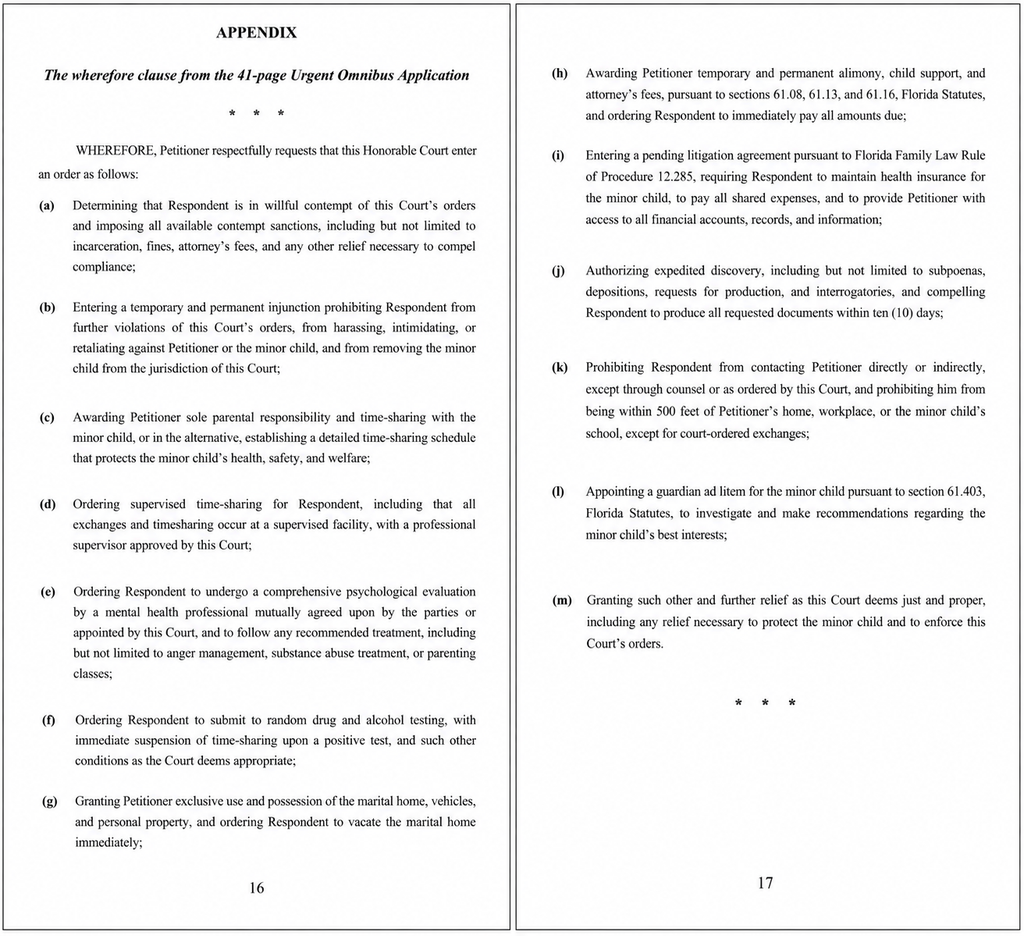
The litigation had produced an extraordinary amount of paper. Counsel filed a 41-page “Urgent Omnibus Application” requesting thirteen forms of relief; an eleven-page emergency motion requesting nine forms of relief; three motions in limine; a 33-page motion to disqualify the trial judge; and, finally, a 61-page emergency petition in the court of appeal.
The court identified several characteristics of the filings that will probably be familiar to lawyers who have spent time experimenting with AI-generated legal writing. There were unnecessary arguments, irrelevant details presented as though they were important, excessive emphasis, and passages that had the outward appearance of legal prose without conveying a coherent legal thought.
The court gave one section of its opinion the heading “Legal Gibberish.” It reproduced this portion of the motion to disqualify:
“The Court admonished her for that judgment. The bind that creates, participate and get shut down on the one hand . . . decline and get admonished on the other, is not a fair proceeding. It is the record of one.”
The bold and italics were in the original filing. The appellate court observed that the filings frequently used bold and italics to emphasize seemingly random sentences and direct the reader toward facts that turned out to be irrelevant. Here, it concluded, “the motion emphasizes legal gibberish.”
The court also criticized something it called “issue churning.” The petition and the other filings, according to the court, repeatedly generated new and scattershot arguments, including arguments that had not been preserved below. The court observed that many AI-generated or AI-assisted documents “aggressively raise scattershot arguments” and that the practice can hurt, rather than improve, a client’s chances of success.
The Lisandrillo filings provide an unusually good visual illustration. The 41-page “Urgent Omnibus Application” concluded with a request for thirteen separate forms of relief. When counsel later sought extraordinary relief, the 61-page petition reproduced the entire wherefore clause of that earlier motion, filling three pages. The Fourth District, in turn, appended the clause to its opinion (see below).
Generative AI, when unrestrained by careful prompting or editing, tends to produce more content than an ordinary writer would. If asked for additional arguments, it will generally provide them. If asked to make an argument stronger, it can make the language more emphatic. If given an irrelevant fact, it can often devise an argument for why that fact matters. None of those abilities necessarily corresponds with good legal judgment.
Indeed, the court thought the problem sufficiently serious that it connected the filings to several Florida Rules of Professional Conduct, including competence, the lawyer’s role as adviser, meritorious claims and contentions, expediting litigation, candor, and fees. Its central concern was independent professional judgment. The court observed that it takes “almost no skill and little time to generate AI slop” and concluded that a lawyer who simply files it has failed to exercise that judgment.
None of this changes our advice to Louisiana lawyers that they should learn to use generative AI. If anything, Lisandrillo reinforces it. It is difficult to develop an appropriate skepticism about AI-generated work without spending some time using the tools and learning how convincing an unfinished product can appear.
AI can be enormously useful in reviewing a record, organizing information, identifying possible arguments, testing an argument, or producing a first draft. But experience with the technology teaches an important lesson: a document that looks finished may not be anywhere close to finished.
The court ultimately recognized that the precise role AI played in these filings was beside the point. Whether the work was “AI-generated, AI-assisted, or something else,” the lawyer signed and filed it and was responsible for it. The court ordered counsel to show cause why sanctions, including a possible referral to the Florida Bar, should not be imposed. It added an unusual instruction: counsel must prepare the response “without the use of AI.”
