

On October 30, 2026, the Louisiana Supreme Court held that a trial court abused its discretion by refusing to enhance a lodestar attorney fee in a class action. In Crooks v. State, through the Louisiana Department of Natural Resources, the court applied a multiplier of three and set class counsel’s fee at $16,713,656.20.
That is triple the trial court’s unenhanced lodestar but well below the Third Circuit’s fourfold award, with interest running from the original 2017 award. Justice Burris wrote for the majority; Chief Justice Weimer dissented in part.
Readers of this blog will recognize the expert at the center of the multiplier fight: our own Professor Dane Ciolino. Both the majority and the dissent built their analysis on his fee affidavit.
In this case, the class sued in 2006 over flooding from a federal navigation project in the Catahoula Basin. Class counsel won the core dispute: the area is legally a river, not a lake, so the class owns roughly 22,800 acres of riverbank. But the damages were another story: in 2020 the Supreme Court held the damages claims had prescribed, cutting the cash recovery from about $42.9 million to about $4.7 million in royalties. The fee then moved through the courts like this:
| Date | Court | Method | Fee award |
|---|---|---|---|
| Oct. 30, 2026 | Louisiana Supreme Court | Lodestar × 3 | $16,713,656.20 |
| Mar. 4, 2026 | Third Circuit | Lodestar × 4 | $22,284,875.00 |
| Dec. 6, 2024 | Trial court (on remand) | Lodestar: 13,108.75 hours × $425/hour | $5,571,218.75 |
| May 15, 2017 | Trial court (original) | Percentage of the monetary award | $22,075,843.82 |
Louisiana presumes the lodestar (reasonable hours times a reasonable rate) is a reasonable fee, to be adjusted only in rare cases. The court tested this case against the strict Perdue v. Kenny A. framework, which bars enhancing for anything the lodestar already captures. The court noted that Perdue governs fee-shifting, and that federal courts use the looser Johnson factors for common fund fees. It did not pick one: the case qualified under both.
Three grounds for enhancement were present
| Perdue ground | What the court found |
|---|---|
| Extraordinary outlay of expenses in exceptionally protracted litigation | A contingency case since 2006, with two trials, five writ applications to the Supreme Court, and over $500,000 in costs carried by counsel |
| Exceptional delay in payment of fees | Fees first awarded May 15, 2017, and still disputed nearly a decade later |
| Lodestar alone would not attract competent counsel | Significant risk, two decades on contingency, novel and difficult issues, and the core goal achieved: the basin declared a privately owned river |
The size of the multiplier came from Professor Ciolino’s 2016 fee affidavit, which the majority cited as further support for an enhancement. He recommended a multiplier of two to four, against a national mean of about 1.75. Three lands mid-range among the cases the court cited.
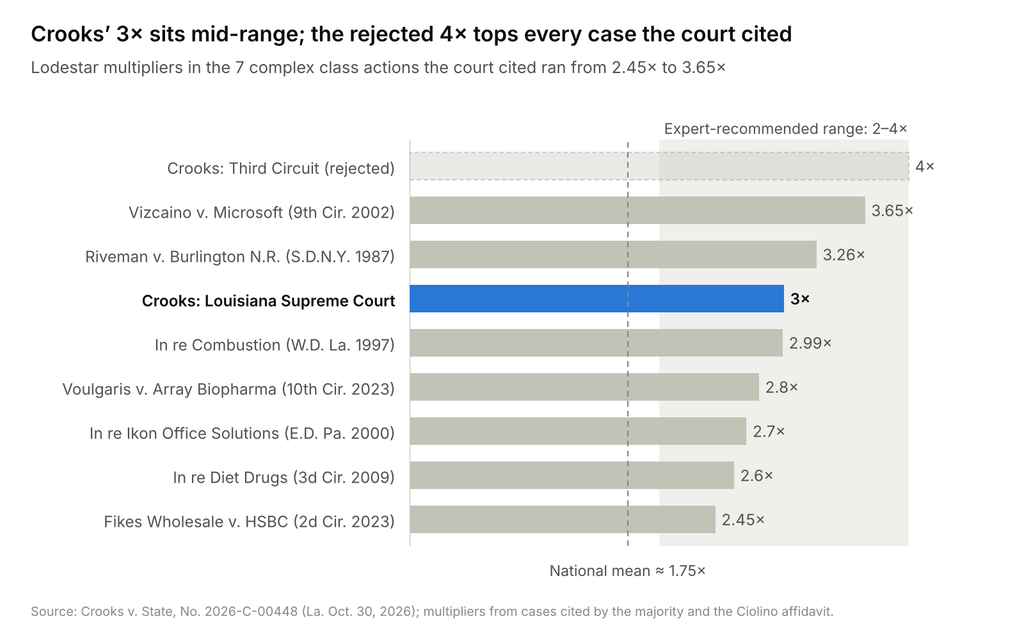
But Professor Ciolino paired that range with a blended rate of $225 to $350 an hour. Because the trial court used $425, the Third Circuit erred by going to the top of the range.
Chief Justice Weimer would have allowed no multiplier, and he built that case on Professor Ciolino’s numbers too. The two-to-four range assumed a $225 to $350 rate, so the trial court’s $425 rate already paid for delay and risk. Enhancing on top of it counts the same factors twice. He also warned that the fund lacks the cash to pay $16.7 million plus interest. Counsel may have to take land or a judicial mortgage on class members’ property, a prospect he found disconcerting.
What this means for fee petitions
- Refusing a multiplier can be reversible. The lodestar presumption is strong, but a trial court abuses its discretion by declining to enhance when the Perdue grounds are present.
- Build the record for the stricter test. The court did not say whether Perdue or Johnson controls. Document years on contingency, trials and writs, costs advanced, and delay in payment.
- Rate and multiplier move together. A premium hourly rate shrinks the room for a multiplier, and expert testimony on both should rest on the same assumptions.
- Non-cash recoveries count. Article 595 lets courts weigh land and future royalties, so a fee can exceed the cash recovery and still be reasonable.
- Plan for collection. The remand on reserves and payment terms may matter as much as the number.
