
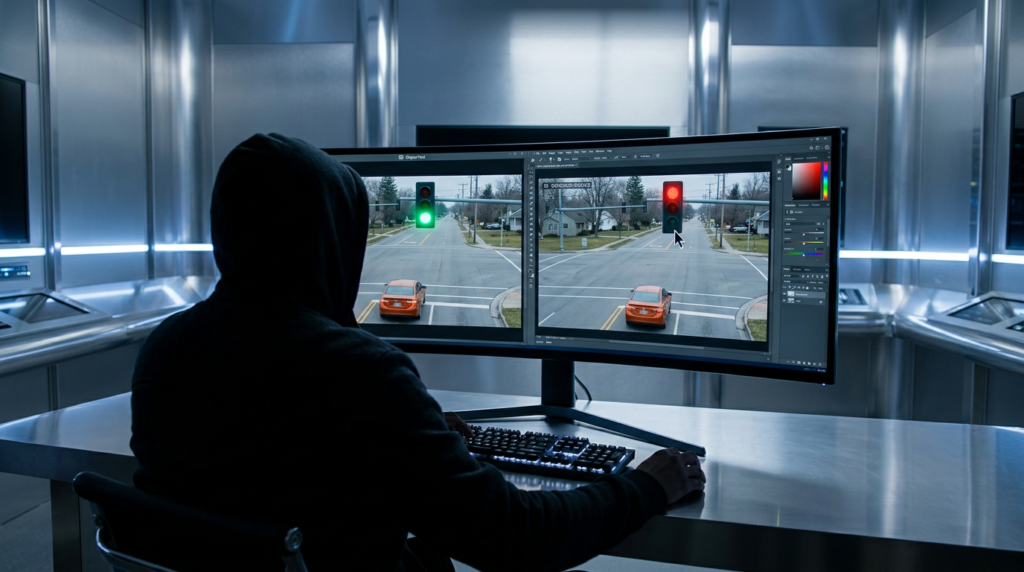
We have been talking for some time about the threat that AI-generated “deepfakes” pose to the justice system. Judges, lawyers, and rulemakers have been talking about it too. As generative AI makes it increasingly easy to create convincing fake photographs, recordings, documents, and videos, courts face a basic evidentiary problem: How do we know that what we are looking at is real?
Last year, a California court confronted what appears to be one of the first documented cases involving deepfake evidence actually presented to a court as genuine.
In Mendones v. Cushman & Wakefield, Inc., self-represented plaintiffs submitted video exhibits that purported to depict an actual witness. But Alameda County Superior Court Judge Victoria Kolakowski noticed something was wrong. According to the National Center for State Courts’ discussion of the case, the witness’s face appeared unusually motionless, the videos contained strange cuts, and some of the witness’s mannerisms appeared to repeat.
The court ultimately determined that the exhibits were not authentic recordings of the witness at all. They were deepfake products of generative AI. The court also found that multiple exhibits had been generated or materially altered with AI. Ultimately, the misconduct was serious enough that the court imposed terminating sanctions, struck the plaintiffs’ complaint, and dismissed the case with prejudice.
The federal judiciary has considered whether the existing authentication rules are sufficient to address this problem.
Under the existing Federal Rule of Evidence 901, the party offering evidence must produce evidence “sufficient to support a finding that the item is what the proponent claims it is.” But deepfakes complicate this framework. A party may be able to provide the ordinary indicia of authenticity for a photograph, audio recording, or video while an opponent has legitimate evidence that the item was actually fabricated or materially altered using AI.
The Advisory Committee on Evidence Rules has therefore been studying a possible new Rule 901(c) specifically addressing potentially fabricated evidence.
Under the Committee’s approach, the ordinary authentication rules would continue to apply unless the opponent first makes a meaningful showing that the evidence may have been fabricated. The opponent would have to produce enough evidence to support a finding that the item was fabricated or altered. A bare accusation that a video “might be AI” would not be enough. But once that threshold is crossed, the burden would change. The proponent would then have to establish that the evidence is authentic by a preponderance of the evidence. In other words, the proposed rule would create a higher authentication hurdle when there is a legitimate reason to suspect fabrication.
Importantly, Rule 901(c) is not currently a proposed amendment that is headed toward adoption. At its May 2026 meeting, the Advisory Committee considered the issue but deferred action. Some members questioned whether a special deepfake rule is necessary at all. Courts have dealt with forged documents, altered photographs, edited recordings, and other fabricated evidence for a very long time. Existing Rules 901 and 104, together with expert testimony and ordinary evidentiary procedures, may prove sufficient.
Whatever ultimately happens to Rule 901(c), lawyers need to refresh and implement their verification practices now.
That does not mean treating every photograph, video, recording, screenshot, or document as presumptively fraudulent. Most evidence remains exactly what it purports to be. But lawyers should be prepared to verify suspicious evidence through its source rather than relying exclusively on the evidence itself. Depending on the circumstances, that may mean obtaining original files rather than screenshots or copies, examining metadata, confirming evidence directly with the person who created or supplied it, preserving chain-of-custody information, comparing copies against their original source, or obtaining forensic assistance when the stakes warrant it.
Law firms should also be training lawyers and staff to recognize the possibility of AI fabrication. Deepfake detection cannot depend entirely on spotting six fingers or an oddly blinking witness. The technology is advancing too quickly for visual intuition alone to be a reliable safeguard. The most important habit may therefore be a very old one: when evidence gives you a reason to doubt it, verify it.
